Ten years of keeping score in the Brussels bubble
The 10th edition of the #EUinfluencer Ranking landed this week at Cardo Brussels. Here is what a decade of measuring the bubble tells us about who shapes Europe’s story now, and who is only just noticing.
The bet
In 2016 the smart money in Brussels thought social media was for interns.
A small group of us disagreed. We were spending an unreasonable amount of time on Twitter arguing about EU policy, and we had noticed something the town wasn’t paying attention to yet: the argument about Europe was moving online, and the people winning it were not the people with the biggest press offices. They were a slightly nerdy minority with sharp opinions and good timing. We called them the EUinfluencers. They met in a pub, at something called an EUtweetUp, and we went along. Then we did something nobody else was doing.
We started counting.
We kept score
Ten editions later, the #EUinfluencer Ranking is the only continuous record of who moves the Brussels conversation. This year’s edition tracks 153 people across five ranked platforms, with three more relegated to honorable mentions. Most retrospectives run on sentiment. Ours runs on a spreadsheet, and the spreadsheet tells a story in three moves. A show of hands at Cardo on Friday gave the live version.
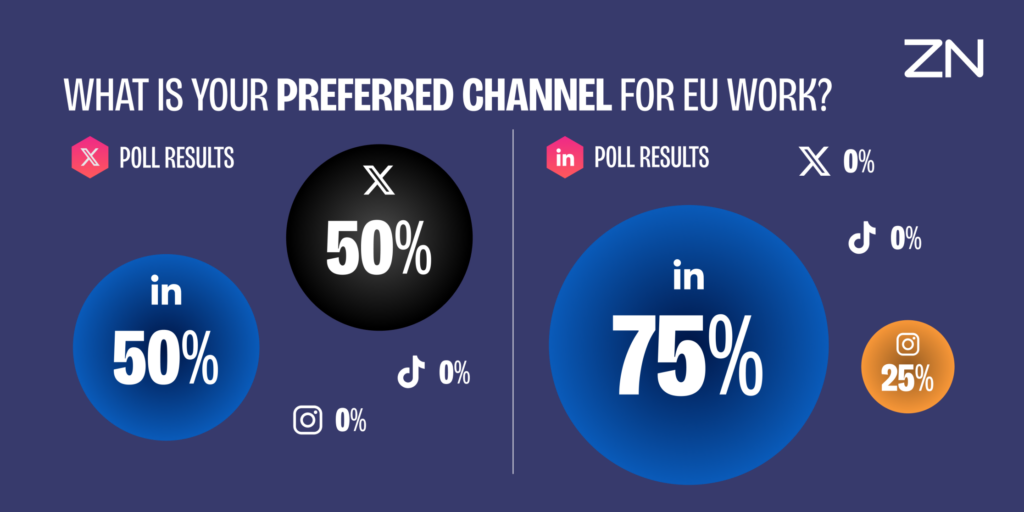
Roughly a third of the room had worked with an influencer in the past twelve months and more planned to do so in the future. Asked for their main channel for the EU conversation, about 80% said LinkedIn, around 5% said X, 10 to 15% said Instagram or TikTok, and the alternatives got Jon Worth and a couple of others. Our polls earlier in the week said the same thing with one twist: on X, respondents split between X and LinkedIn; on LinkedIn, they chose LinkedIn, and a quarter of them named Instagram.
In 2017 there was one platform that mattered. Twitter was the newswire, the debating chamber, the job board and the green room. Dave Keating said it on our stage in 2022: because every journalist and politician was on Twitter, it set the agenda for what everyone else thought was important. The whole European debate about Europe’s future ran on one American platform, and nobody thought that was worth remarking on. It was just the weather.
Then Musk bought Twitter in 2022, renamed it, throttled links, cut trust and safety, and made himself a political actor in European debates. The bubble kept its accounts and quietly stopped using them for anything that mattered.
Ten years ago, ranking influence was almost arithmetic: one platform, one number. That world has gone. The 2026 ranking is five different rooms, each with its own crowd. Kait Bolongaro, newly appointed Senior Editor at The Capitol Forum, told our first panel that Brussels media is going the same way: more and more niche outlets addressing one very specific community, until the media sphere looks like the platforms do.
LinkedIn is where policy is discussed now. Hunderd people ranked, and more than half of them run something: six Directors General in the top ten alone, from DIGITALEUROPE to FoodDrinkEurope to SolarPower Europe. Journalists are 13% of the list. This is the lobby talking to itself in public, across eleven policy areas, with an academic as referee. Even the newsrooms have moved. Kait Bolongaro said her rule for reporters was LinkedIn first: get out there, build the expertise in public, and the visibility feeds back into trust in the reporting. Number one is Alberto Alemanno, for the second year running. A professor, not a reporter.
Whether it is a conversation is another matter, and our third panel disagreed about it on stage. Karen Massin of Google said LinkedIn has become the digital town hall, the place where she can actually speak to her community, and that she now posts video because people are bored of reading. Michiel van Hulten, sitting next to her, said that he found it too formal, too one-way, useful for information and not much good for debate. The room’s hands were with Karen. The room’s nostalgia was with Michiel. This is probably worth another Linkedin debate.
X is where geopolitics is reported. Fifty-five ranked, half of them journalists, and 39 of the 55 sit in just two topics: foreign affairs and trade. X did not die in Brussels. It narrowed into a wire service run by correspondents, and three quarters of them are men.
Bluesky is where journalists went to wait. It has the highest share of reporters of any platform we track, and the smallest audience. This year we tracked 39 voices. Journalists are present however the conversation is not.
Instagram and TikTok are where the new voices live. The lists are short, young, gender balanced, and dominated by creators and activists rather than institutions. The Instagram number one is Chloe Mikolajczak, a climate activist with 111,000 followers. Number two, Sevim Aktas, works for a Commissioner and posts what the Berlaymont looks like from the inside. Number three, Olivia Lori, is a PhD student and disabilities advocate who explains EU policy to people who will never read a directive.
One number frames all of it. Of the 153 people we rank, 104 are influential on exactly one platform. Eight are on three or more. If influence in Brussels has gone multi-platform, influencers, mostly, have not.
Check out the full rankings here.
Brussels was late to the influencer game
Brussels likes to think of itself as a special case. On this trend, it is a late one.
The Reuters Institute’s Digital News Report, published in June, made the finding we spent nine years defending: for the first time, social media and video networks are the most widely used source of news globally, ahead of news organisations’ own websites and television. A quarter of people get news from creators who focus on news; nearly half get some news from creators of any kind. Trust in news, meanwhile, has fallen to 37%, the lowest level Reuters has recorded.
Edelman’s 2026 Trust Barometer explains where that trust went. It didn’t vanish. It contracted into smaller circles, and the people inside those circles are disproportionately creators. Nearly half of respondents trust an influencer they follow, and six in ten of them would reconsider a company they distrust if that influencer vouched for it. Reach is no longer the point. Proximity is.
The political class outside Europe has drawn the obvious conclusion. American campaigns now pay creators the way they once bought TV slots, and at least one governor’s re-election rally this year ran on “credentialed creator access only”. If you are trying to shape a narrative that shapes policy in 2026, a strategy without creators is a strategy with a hole in it.
Now Brussels has landed
In 2026, the institutions stopped watching and started inviting.
Two days before our event, Ursula von der Leyen gave her State of the Union in Strasbourg: associate membership for Canada, a European Security Council, a heatwave plan, new limits on social media for children. Content creators were in the building, and not in the cheap seats. Méabh Mc Mahon, Euronews’ chief anchor and the holder of an access-all-areas press badge, put it to our audience with some feeling: hundreds of influencers got close access to the President in Strasbourg this week. When did she last give an interview to a media outlet? Then she polled the room on whether creators should get summit badges. The hands were split.
The Council of the EU launched a programme in July that brings content creators into parts of its headquarters previously reserved for accredited press. The Commission enlisted 50 creators for its “Protect What Matters” campaign on security and democracy. The Parliament ran a Content Creators Summit. Ursula von der Leyen has met influencers repeatedly and invited them to her State of the Union. NATO is at it too. And the traffic runs both ways: the second most influential EU voice on Instagram this year is a Commission communications adviser, ranked on her own account, not the institution’s.
There are conditions, of course. The creators are accompanied. They cannot ask questions. They are, in the Council’s own framing, not treated as media. The Brussels press corps has noticed, and is not entirely delighted. But the direction is unmistakable: what the top of our ranking was doing in 2018, the institutions are now doing in 2026.
Alberto Alemanno put the problem plainly at our 2025 edition: it isn’t the institutions’ job to explain the EU, it’s the MEPs’ job, and most of them are faceless. A year later the institutions have decided that if the elected can’t be faces, the creators will be.
The other institution turned ten this week. The real ones started sending invitations.
Méabh described what that looks like from a newsroom. In 2010 an EU summit came with a crew: editor, sound engineer, producer, researcher. Now it is a one-woman show, and every Commissioner and think-tanker is an expert at the walk-and-talk, so journalists have to find a way into that field too. “Influencers are probably the future,” she said. “I am an endangered species.” The endangered species then noted that Euronews’ clips on the State of the Union and the Canada deal had done two million hits on social this week, that Sharon Stone had liked one, and that the network is investing in Instagram even though it cannot make money there, because that is where the people are. Endangered is not the same as extinct.

Mainstream does not mean simple
Three things make the 2026 landscape harder to read than the 2017 one, and each of them is a reason to keep counting.
The conversation split, and so did the audience. LinkedIn carries the policy conversation: the directives, the consultations, the arguments among people who read footnotes. Instagram and TikTok carry the political conversation, and outside our ranking, which excludes politicians on principle, the politicians using them best are mostly not the ones the bubble approves of. In Romania, a candidate polling at 1% led the first round on the back of TikTok. In Germany’s 2025 election, the AfD dominated TikTok while the Greens barely registered, and most of that dominance came not from the party but from its fans. Europe’s mainstream is still learning a language its opponents already speak. The people who do speak it rarely came through a press office.
The alternatives haven’t arrived. Bluesky has most of the Brussels press corps and almost none of the Brussels conversation. Michiel van Hulten, who left X over Musk and took his 20,000 followers’ worth of goodwill to Bluesky, made the point himself, and it was not a sales pitch. What he misses about Twitter was how egalitarian it was: everyone on it, from people following along at home to the top of politics, all in the same conversation. Bluesky’s biggest advantage, he said, is that it is not addictive. That is also its downside. No engagement-based ranking, plenty of ideas, none of the vibe. Coming from Bluesky’s most committed Brussels convert, that is the verdict. Thirty-nine people in our ranking cleared the bar there this year, down from 120. Michiel, for the record, admitted he told a colleague in 2007 that Twitter wouldn’t last. He was, he pointed out, technically right. Threads and Mastodon have fallen out of our rankings altogether; the qualified pool on each is too thin to order. For now they are precautions, not platforms.
Trust is the currency, and it’s inflating. Creators are trusted less than newsrooms, and people know it. Reuters finds that most people who follow creators do so alongside traditional media, not instead of it, and that the pull of creators is weakest in Europe, where established media still hold. Kaj Embrén, who has spent years moving dry subjects like coal mine methane into public argument, put it simply on our first panel: for people who work in communication it is a question of trust, and if you have trust, you can influence. Kait Bolongaro added the corollary from the journalism side: trust is built by being honest, accurate and authentic, and those principles apply to influencing as much as to reporting. In other words, the influencer is not the whole campaign. The influencer is the part of the campaign that makes the rest of it believable.
And one thing about European independence worth noting. Every platform in this article is owned somewhere else, mostly in the United States, and the Commission’s own figure is that Europe depends on outsiders for over 80% of its key digital infrastructure. The EU tried hosting its own square, on Mastodon, and closed it in 2024. Cristina Vanberghen put it this way in her #EUinfluencer interview last year: the platforms run on rules set by a few corporations, which decide what gets amplified and what fades into invisibility, and in doing so shape not just the conversation but what counts as true and what counts as important. Europe’s argument about its own independence still runs on rails it does not control. That does not change the strategy. It does raise the stakes.
What the new voices are actually doing
The people filling that gap are not doing institutional communications with better lighting. They are doing the thing the institutions cannot.
Olivia Lori, third on our Instagram ranking and second on TikTok, came to Brussels four years ago on a Council traineeship for people with disabilities and started making content after running into the bubble’s inaccessibility herself, in recruitment and in the buildings. Her most-watched video is five seconds long: the Commission’s live stream, and the question of why an institution that translates live into 24 languages cannot manage live subtitles. Europe, she told the room, cannot afford to leave millions of its citizens behind. We had live captions running at Cardo because of that video (although we had few technical hick-ups).
She also drew the line the whole evening kept circling. Creators are not journalists, she said: journalists inform and let you form your opinion, creators turn information into content and usually add theirs. In a crisis, when AI can fake anything, she goes to traditional media. The influencer on the panel was the one defending the newsroom.
Otilia Colceriu of EU and U, which started in the wake of Brexit and blew up in the pandemic, opened with a deliberately unfashionable take: the institutions are not doing that badly, and they have gotten better. What she wants is plain language and a reason: explain to me why it matters, in Romania, that this is happening in Brussels, and use someone from my hometown to say it. Her formula for what works with Gen Z is three formats. The informational carousel, the meme, which has to be fast and the occasional angry video with a face on it, calling people to sign, vote or write to their MEP. Funny or angry, she said, always works.
Julius Fintelmann co-founded The European Correspondent to write for European citizens rather than for the bubble. It launched as a newsletter; Instagram is now its biggest channel by far, the first touchpoint for a younger, more urban reader who is then upsold to the newsletter, and it publishes in six languages with AI doing the first pass and a human editor in each. He offered the most useful explanation of the whole trend. Decades of reader surveys say the one thing people want from journalism is less bad news, and media has not served that demand. Creators do well because they are relatable, and because they manage to say: you are not alone. Many of them, he added, are journalists who chose a different format, and newsrooms that adapted early are seeing the benefit.
That is the part no press office has cracked, and no model can fake.

The next ten
A decade ago we bet that social media would become a serious arena for EU policy. It did. The next bet is already in the data: 16% of under-35s now get news from an AI chatbot, and the internet is filling with content nobody wrote.
Half the room at Cardo already uses AI to write. A handful never do, and they were mostly journalists. Our third panel was refreshingly unbothered about the machines taking the work. Francesco Piccinelli Casagrande, whose MEP Analytics tracks policy conversations with AI, told the room their jobs were safe: what AI is good at is situational awareness, turning 50 hours of reading into one, so that lobbyists can do the actual job, which is talking to people. Karen Massin agreed and named the catch. It does not mean going home at three for drinks. It means the company expects more, faster; it means 2,800 amendments you cannot afford to miss one of; it means getting a summary of the State of the Union to her executives before the newspapers did. And it means, she said, that the quantity work public affairs used to buy in is going in-house. What is left to buy is judgement. Michiel’s version was shorter: there will always be an appetite for the personal touch, the bright idea and the quirkiness, and no model has that yet.

Welcome to the age of the influencer

Ten years ago we asked a simple question: who are the people shaping the conversation about Europe? The honest answer in 2016 was that most of Brussels did not think the question mattered. It does now. It matters to the Commission, which fills its State of the Union gallery with creators. It matters to the Council, which lets them past the press line. It matters to Euronews, which clips its own anchor for Instagram, and to the newsroom that tells its reporters LinkedIn first. And it matters to the third of the room at Cardo who worked with an influencer this year, and the larger share who intend to.
So here is the conclusion, and it comes with no hedge. We have entered the age of the influencer. Social media is no longer where the EU conversation is echoed; it is where the conversation happens, and the people who carry it are individuals with names, faces and communities of their own. That is true whether the bubble likes it or not, and much of the bubble does not. It is true for policy on LinkedIn, for politics on Instagram and TikTok, for geopolitics on X, and it will be true on whatever platform comes next.
AI does not weaken this. It makes it stronger. The more of the internet is written by nobody, the more people go looking for somebody: not a brand, not a feed, not a summary, but a person with a name, a face and a track record, someone they can follow, argue with, and decide to trust. Reuters has measured the drift. Edelman has measured the trust. Our ranking has measured the names for ten years. They all point the same way. Old bubble, new voices, and the voices are winning.
For anyone trying to shape what Europe decides, the implication is practical. Influencers are not a channel you add at the end of a campaign. They are the part of the campaign that makes the rest of it believable, and a strategy that leaves them out in 2026 is a strategy with a hole in it. We have been mapping this community since it was a nerdy hobby. A decade of staying #OneStepAhead has taught us three things: map the voices, measure what moves, and build the relationships before you need them. If you want an ecosystem of influence inside your next campaign rather than a single loud voice, you know where we are.